

From July 1st, 2026: The government is strongly shifting from pre-approval to post-approval and digitizing the construction investment process.
25/06/2026A series of new policies will take effect from July 1, 2026.
From July 1, 2026, many important documents related to investment, construction, environment, and project management will officially come into effect. Notable among these are Resolution 66.18/2026/NQ-CP, Resolution 66.19/2026/NQ-CP, Decree 217/2026/ND-CP, Decree 212/2026/ND-CP, and Decision 1165/QD-BTC.
Looking at each document individually, these are changes in various fields. However, when considered together, a very clear direction of the Government can be seen:
> Reducing pre-approval, increasing post-approval, and promoting digitalization throughout the entire lifecycle of investment and construction projects.
For investors in factories, industrial parks, logistics warehouses, or businesses planning to expand production, these changes can directly impact investment preparation time, implementation progress, and legal compliance costs.
Resolution 66.18: Reducing Fire Safety Procedures, Easing Pressure on Project Progress
For many years, fire safety has always been one of the procedures that businesses are concerned about because it directly affects the time when a project can be put into operation.
According to Resolution 66.18/2026/NQ-CP, many administrative procedures in the field of fire safety have been reduced or simplified. Most notably, the procedure for inspecting and accepting fire safety work has been abolished for many cases where the design has already been approved.
This change directly impacts projects such as:
* Manufacturing plants;
* Industrial workshops;
* Logistics warehouses;
* Cold storage facilities;
* Distribution centers;
* Commercial and service buildings. Previously, many projects had completed construction but still had to wait for acceptance procedures to be eligible for operation. With the new mechanism, the time to prepare for putting projects into use is expected to be significantly shortened.
However, this does not mean that safety standards will be relaxed. The responsibility of the investor, design unit, and construction contractor will be higher as the post-inspection mechanism is strengthened.
Resolution 66.19: Not all projects still need to apply for an Environmental Permit
If Resolution 66.18 impacted fire prevention and control, Resolution 66.19/2026/NQ-CP is considered one of the biggest changes in the environmental field.
According to the new regulations, the scope of projects that must apply for an Environmental Permit has been significantly narrowed. Some industries with high pollution risks are still subject to strict management, including:
* Inorganic chemicals;
* Chemical fertilizers;
* Pesticides;
* Metallurgy from ore;
* Paper production with pulp production stage;
Processing of hazardous minerals.
Projects in this group still require an Environmental Permit when:
- Wastewater requiring treatment is 100 m³/day or more;
- Or exhaust gas requiring treatment is 100,000 m³/hour or more.
Conversely, many common industrial projects such as:
* Mechanical factories;
* Electronics factories;
* Food factories;
* Logistics warehouses;
* Cold storage;
* Some projects converting LPG fuel to LNG or CNG;
may have simplified environmental procedures and in many cases only require environmental registration instead of applying for an Environmental Permit as before.
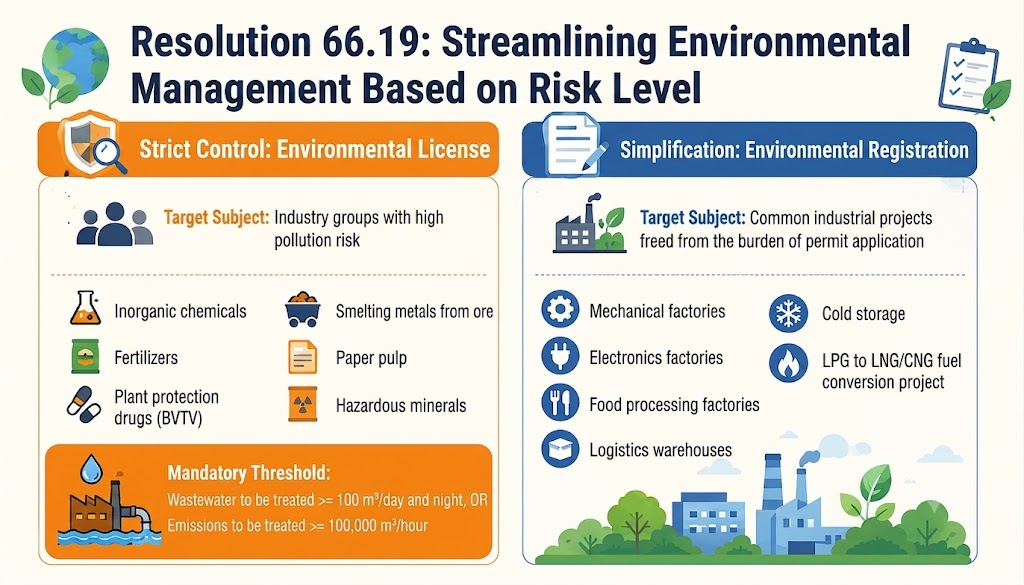
This change is considered to have a significant impact on the investment preparation time for businesses, especially for production expansion projects or the construction of new factories.
Decree 217: Improving the Mechanism for Managing Construction Activities
At the same time, Decree 217/2026/ND-CP on the management of construction activities officially came into effect and replaced Decree 175/2024/ND-CP.
The noteworthy point of the decree lies not in a single procedure but in the general direction:
* Standardizing documents;
* Reducing intermediate steps;
* Increasing interconnectedness between management agencies;
* Limiting overlapping in the process of implementing construction investment procedures.
For investors, the biggest benefit is the ability to shorten project preparation time and reduce administrative costs incurred during implementation.
In an increasingly competitive market, saving a few weeks or months in investment preparation can create a significant advantage in terms of timeline and capital efficiency.
Decree 212: Each project will have a unique identification code
Besides streamlining procedures, the Government is also promoting the digitalization of construction investment management.
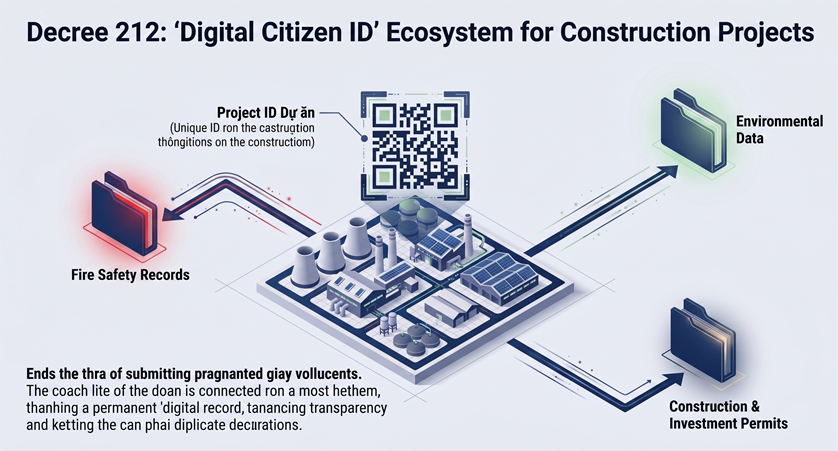
According to Decree 212/2026/ND-CP, each construction investment project will be assigned a unique identification code in the information system on construction activities.
Simply put, this is the "citizen's identity card" of the project.
Through this code, data related to investment, construction, environment, and other procedures will gradually be interconnected on the same system.
Although the impact may not be immediately visible in the short term, this is an important foundation for the formation of digital project records in the future, helping to reduce duplicate declarations and enhance transparency in management.
Decision 1165: Continuing to cut down on investment procedures
The trend of procedural reform is not only happening in the construction or environmental sectors.
According to Decision 1165/QD-BTC, the Ministry of Finance has announced the abolition of 10 administrative procedures in the investment sector, while amending and simplifying many other procedures.
Although each change is individual
It may not seem like a huge amount, but when combined with reforms in fire safety, environment, and construction, businesses will significantly reduce the time and resources spent on administrative tasks.
What remains unchanged: The investor's responsibility is increasing
The most notable point in this reform is that although procedures are streamlined, the responsibility of businesses has not decreased.
On the contrary, as the State shifts from pre-inspection to post-inspection, requirements regarding:
* Design quality;
* Compliance with technical standards;
* Construction quality;
* Project management documentation;
* Operation;
will receive increasing attention.
In other words, businesses are given more favorable conditions during the investment process, but at the same time, they must be more proactive in controlling risks and ensuring compliance with the law.
Conclusion
From July 1st, 2026, a series of new policies are showing a very clear management direction: reducing pre-inspection, increasing post-inspection, and promoting the digitalization of investment and construction activities.
From cutting fire safety procedures according to Resolution 66.18, narrowing the scope of environmental permit issuance according to Resolution 66.19, perfecting the construction management mechanism according to Decree 217, implementing project identification codes according to Decree 212, to further simplifying investment procedures according to Decision 1165, all aim to create a more transparent, efficient, and favorable investment environment for businesses.
For industrial investors, this is an opportunity to shorten project implementation time. However, in the context of increasingly accelerated post-inspection and digital transformation, thorough preparation of documentation, design according to standards, and professional project management will become more important than ever.
Latest news
Related Posts