

Propane/Butane Ratio in Industrial LPG: What Factories Need to Know
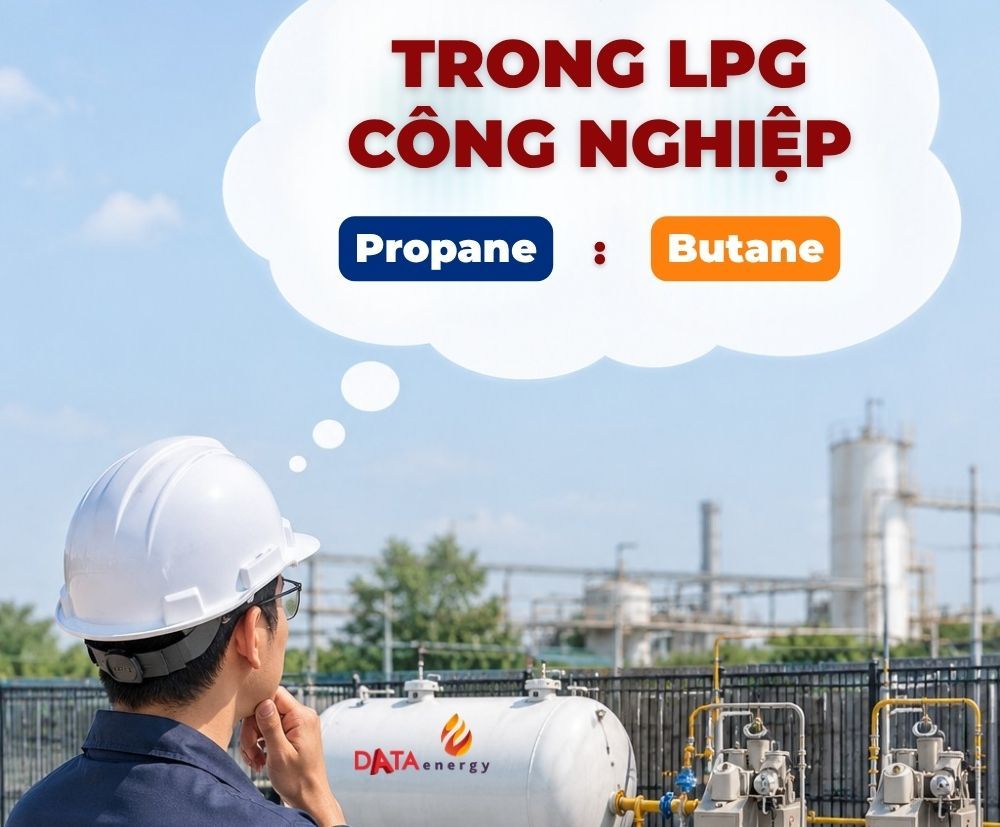
16/10/2026LPG (Liquefied Petroleum Gas) is not a uniform substance. It is a mixture of Propane (C₃H₈) and Butane (C₄H₁₀) — and the propane butane ratio in LPG, commonly referred to as the P/B ratio, directly affects vapour pressure, vaporisation behaviour, and combustion efficiency under real operating conditions at your facility.
Many factories purchase LPG without paying attention to the P/B ratio — focusing only on price and volume. This article explains how the propane butane ratio in LPG works, why the 50/50 blend is the commercial standard in Vietnam, and when it makes sense to consider a different ratio.
1. How Do Propane and Butane Differ?
Both belong to the saturated hydrocarbon group, but Propane and Butane have significantly different physical and thermodynamic properties — and these differences determine how LPG behaves under real operating conditions.
|
Property |
Propane (C₃H₈) |
Butane (C₄H₁₀) |
|
Lower Heating Value (LHV) |
46.36 MJ/kg |
45.75 MJ/kg |
|
Boiling point (1 atm) |
−42.1°C |
−0.5°C |
|
Vapour pressure (25°C) |
~8.5 bar |
~2.4 bar |
|
Vapour density (air = 1) |
1.52 |
2.01 |
|
Explosive range (vol %) |
2.1 – 9.5% |
1.8 – 8.4% |
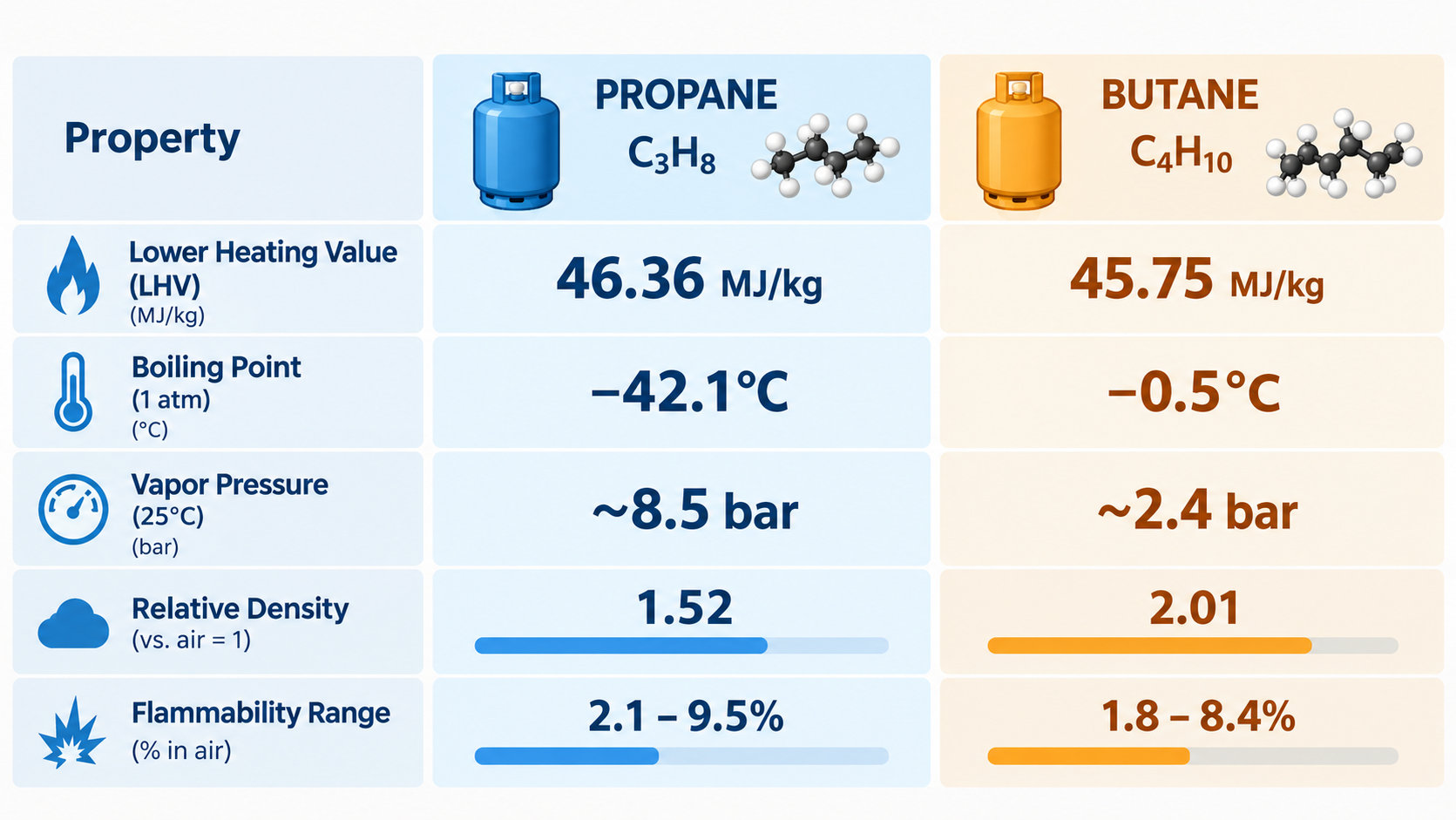
The key point about the propane butane ratio in LPG: Butane has a boiling point close to 0°C (−0.5°C at 1 atm). In cold climates or artificially cooled environments, Butane in the tank may not vaporise sufficiently to generate the pressure needed for burner operation — this is why higher Propane ratios are used in countries with cold winters. In Vietnam, with average temperatures of 25–35°C year-round, Butane vaporises completely and stably — presenting no technical issue.
2. Common P/B Ratios — Which Is the Standard?
In Vietnam's industrial LPG market, the propane butane ratio in commercial LPG comes in four common variants, but their availability differs significantly:
|
P/B Ratio |
Characteristics |
Applications & Notes |
|
70/30 (Propane-rich) |
High vapour pressure; vaporises to −30°C |
Cold climates, freezer rooms — very few suppliers carry this in Vietnam; special order required |
|
60/40 |
Good balance; relatively common in temperate regions |
Plants needing stable pressure during mild winters |
|
50/50 ✦ Commercial standard |
Balanced cost and technical performance — the default blend for all major Vietnamese suppliers |
Boilers, ceramics, food, textiles — suited to Vietnam's tropical climate |
|
30/70 (Butane-rich) |
Low vapour pressure; condensation risk near 0°C |
Consistently hot regions; low-pressure domestic/commercial burners |
? Market reality: Without a specific P/B agreement, factories receive 50/50 LPG — the default standard for all major distributors in Vietnam. The 50/50 ratio balances import cost (Propane is typically more expensive than Butane on international markets) with full technical performance in tropical climate conditions.
3. How Does the P/B Ratio Affect Boilers and Combustion Equipment?
Understanding the propane butane ratio in LPG helps operations engineers make more precise technical decisions. The ratio affects three key operational parameters:
Vapour pressure and vaporisation rate
When ambient temperature drops or the LPG tank runs low, Butane in the blend becomes harder to vaporise than Propane due to its higher boiling point. With 50/50 LPG in Vietnam's tropical conditions, vaporisation is fully stable. Only when tanks are located near artificially cooled areas, or ambient temperature regularly falls below 15°C, should the propane butane ratio in LPG be re-evaluated with the supplier.
Heating value and gas consumption
Propane has a lower heating value than Butane on a volumetric basis, but higher on a mass basis. In practical boiler and kiln operation, the difference in heating value between 50/50 and 70/30 LPG is under 2% — producing no meaningful difference in steam output or furnace temperature. No equipment adjustment is needed when switching between these two ratios if the burner was correctly commissioned from the outset.
Burner adjustment when changing the P/B ratio
Propane and Butane have different oxygen requirements during combustion: Propane requires approximately 5 mol O₂/mol fuel, Butane requires approximately 6.5 mol O₂/mol. When switching to a propane butane ratio in LPG different from the equipment's original design specification, a technician must re-check the burner's air-to-fuel ratio. Skipping this step can lead to incomplete combustion, producing CO or carbon soot — affecting furnace efficiency and equipment service life.
⚠️ Before switching to LPG with a P/B ratio different from the original design specification, contact a combustion engineer or equipment manufacturer to inspect and recalibrate the burner.
4. Propane/Butane Ratio by Industry
The following table outlines the recommended propane butane ratio in LPG for each application type under Vietnam's climate conditions:
|
Industry / Application |
Suitable P/B Ratio |
Reason |
|
Industrial boilers (≥500 kg/h) |
50/50 — standard |
Continuous stable vaporisation; standard burner performs well in tropical conditions |
|
Ceramic kilns (1,000–1,300°C) |
50/50 — standard |
Sufficient heating value, clean combustion, easy temperature control |
|
Food & beverage processing |
50/50 — standard |
Requires completely clean combustion; no residue contamination in product |
|
Cold storage / freezer rooms |
60/40 or 70/30* |
Low ambient temperature significantly reduces Butane vapour pressure |
|
Portable equipment, construction sites |
50/50 — standard |
Standard cylinders widely available; suited to Vietnam's climate |
|
Domestic & commercial (stoves, ovens) |
50/50 — standard |
Adequate pressure, safe, competitively priced |
* The 70/30 and 60/40 blends are speciality products, carried by very few suppliers in Vietnam. These ratios apply only in specific technical circumstances — they are not standard market options.
5. Frequently Asked Questions About the Propane/Butane Ratio in LPG
Does 70/30 LPG burn more powerfully than 50/50?
Not significantly. The difference in heating value between 70/30 and 50/50 LPG is under 2% — not enough to produce a meaningful difference in boiler or kiln operation. The propane butane ratio in LPG should be selected based on environmental conditions and supply availability, not on the assumption that higher Propane means more power.
Can I order 70/30 LPG from a domestic supplier?
Theoretically yes, but in practice very few suppliers in Vietnam carry this product. LPG 70/30 is a speciality blend, usually made to order, with longer lead times and higher cost than the standard 50/50. In tropical conditions, the technical benefit over the standard propane butane ratio in LPG (50/50) is negligible.
What is the P/B ratio in a standard 45 kg LPG cylinder?
Standard consumer and industrial LPG cylinders in Vietnam contain 50/50 LPG. This ratio is maintained consistently by major suppliers including Petrovietnam Gas, PV Gas South, and Saigon Gas — in line with local climate conditions and domestic market demand.
Does the propane butane ratio in LPG change seasonally in Vietnam?
In countries with distinct seasons (South Korea, Japan, Europe), suppliers increase the Propane ratio in winter to ensure adequate vaporisation. In Vietnam, the climate is relatively stable year-round, so most suppliers maintain a consistent 50/50 blend — no seasonal adjustment is required.
How do I verify the propane butane ratio in LPG for the batch I am receiving?
Request a Certificate of Analysis (CoA) or quality inspection report from your supplier for each batch. This document states the Propane, Butane, and other hydrocarbon content by weight percentage or mole percentage — providing the basis for verifying the actual propane butane ratio in LPG delivered.
More info: LPG Quality – Performance and Safety in Use
Conclusion
The propane butane ratio in LPG is a technical specification that directly affects operational performance, yet is frequently overlooked during procurement. For factories in Vietnam:
● 50/50 LPG is the most common commercial propane butane ratio in LPG — climate-suited, available from every supplier, and fully capable for industrial boilers, kilns, and combustion equipment.
● 70/30 LPG is a speciality product — for specific technical requirements only, available from very few suppliers, with no clear technical advantage under tropical conditions.
● When selecting an LPG supplier, prioritise combustion system quality and technical support capability over the P/B ratio — those are the factors that create real performance in long-term operation.
Latest news
Related Posts