

Pure Methane, CNG, and LNG: Three in one
23/07/2026In practice, many customers inquire about purchasing "methane in cylinders" for use as industrial fuel. This reflects a common misunderstanding: pure methane in cylinders, CNG, and LNG may all originate from the same natural gas source, but through different processing routes, they become three products that differ completely in composition, pressure, storage form, and intended application.
To avoid purchasing the wrong product or specifying requirements that don't match actual needs, this article clarifies these differences from the ground up.
The Same Origin: Natural Gas from Gas Fields
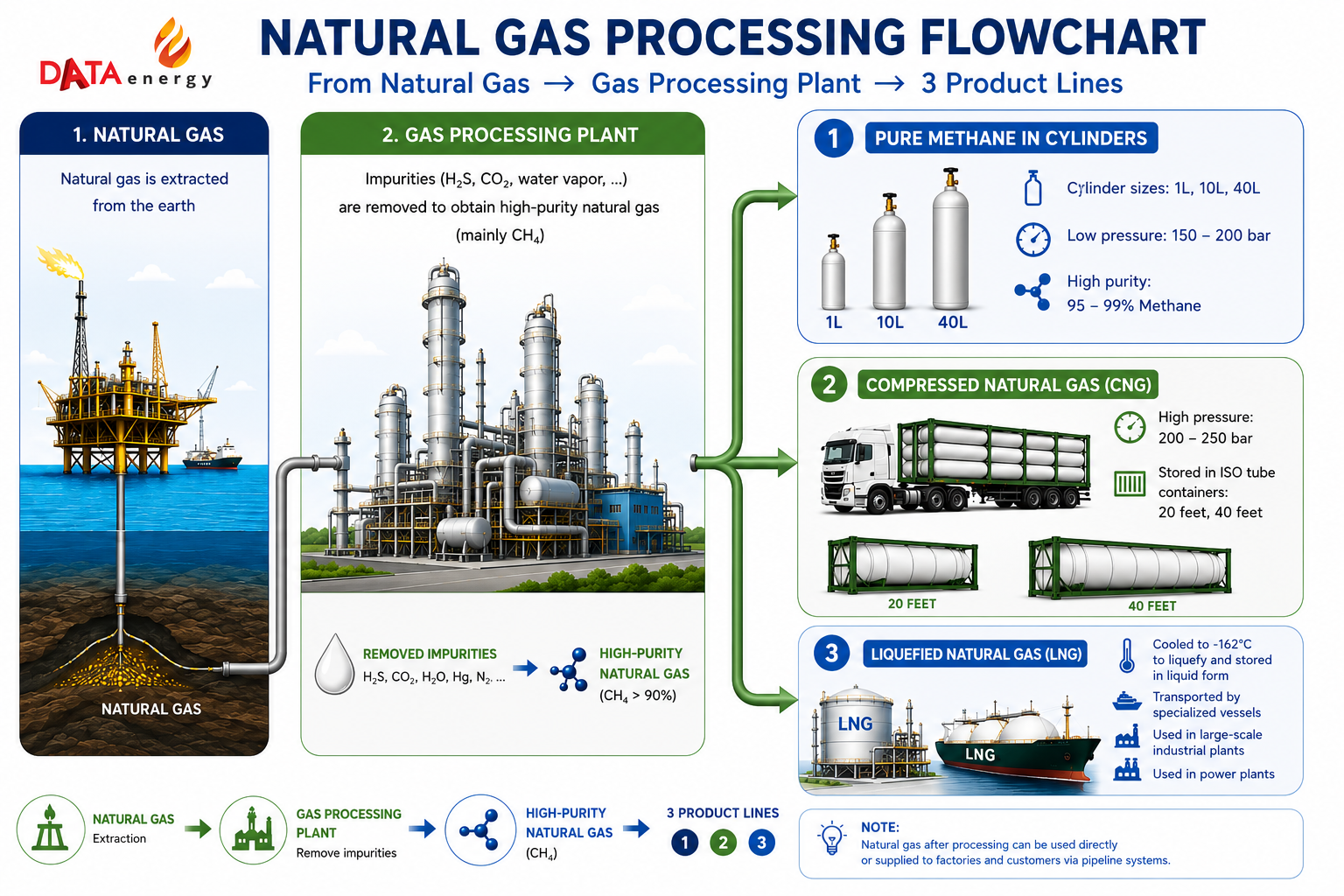
Methane (CH₄) is the primary component of natural gas, accounting for approximately 70–90% by volume depending on the field. Raw natural gas extracted from wells cannot be used directly — it contains impurities such as CO₂, H₂S, water vapor, and heavier hydrocarbons. All natural gas must therefore pass through a gas processing plant to be cleaned and brought up to usable standards.
After initial processing, the methane-rich gas stream is directed into one of three routes depending on the desired level of refinement and storage form:
→ Route 1: Further deep purification (adsorption or cryogenic distillation) → Pure methane in cylinders
→ Route 2: Drying, meeting fuel standards, then compressed to high pressure → CNG
→ Route 3: Liquefied at extremely low temperature → LNG
These three routes produce three distinct products — even though they all start from the same gas.
Distinguishing Pure Methane, CNG, and LNG
Pure Methane in Cylinders (1L, 40L…)
This is CH₄ that has undergone deep purification to achieve very high purity, typically from 99.9% to 99.999%. To reach this level, the gas must pass through adsorption or cryogenic distillation processes to remove all remaining impurities after the gas processing plant.
Storage form: Pure methane at room temperature and standard pressure is a gas — it does not liquefy like LPG. To pack a sufficient quantity into a small cylinder, it must be compressed at very high pressure, typically 150–200 bar, in specialized thick-walled steel cylinders requiring high-pressure valves and fittings.
Application implication: Due to its extremely high purity and high production cost, pure methane in cylinders is primarily used in laboratories (gas analysis, instrument calibration, research), semiconductor electronics manufacturing, or processes requiring tightly controlled gas input. Using this product as fuel for industrial boilers or kilns is economically unsuitable — the cost would be many times higher than CNG or LNG.
CNG — Compressed Natural Gas
CNG is natural gas — primarily CH₄ at 85–95%, with small amounts of ethane, propane, and other hydrocarbons — that after drying and meeting fuel standards is compressed to 200–250 bar and stored in specialized tanks or transport vehicles.
Storage form: CNG remains in gaseous form — it does not liquefy. High pressure allows a large quantity of gas to be stored in a tank, but CNG's energy density is lower than LNG (approximately 38.7 MJ/m³ vs. approximately 22,000 MJ/m³ for LNG). This means CNG tankers need greater volume capacity to transport the same energy content as LNG tankers.
Application implication: CNG is suitable for factories with moderate consumption, located in areas with CNG logistics infrastructure, and that do not want large upfront investment in storage systems. CNG is also lighter than air (methane density is about 60% of air), so in the event of a leak it rises rather than accumulating at low points like LPG — an important safety characteristic in production environments.
LNG — Liquefied Natural Gas
LNG is natural gas — similar composition to CNG, primarily CH₄ — cooled to approximately -162°C at atmospheric pressure until it liquefies. In liquid state, LNG volume is reduced to about 1/600th of its gaseous volume — which is why LNG has far superior energy density compared to CNG.
Storage form: LNG requires cryogenic tanks (specialized insulated vessels maintaining extremely low temperatures) to maintain its liquid state. This infrastructure requires higher investment than CNG, but allows storing a much larger quantity of gas in the same footprint.
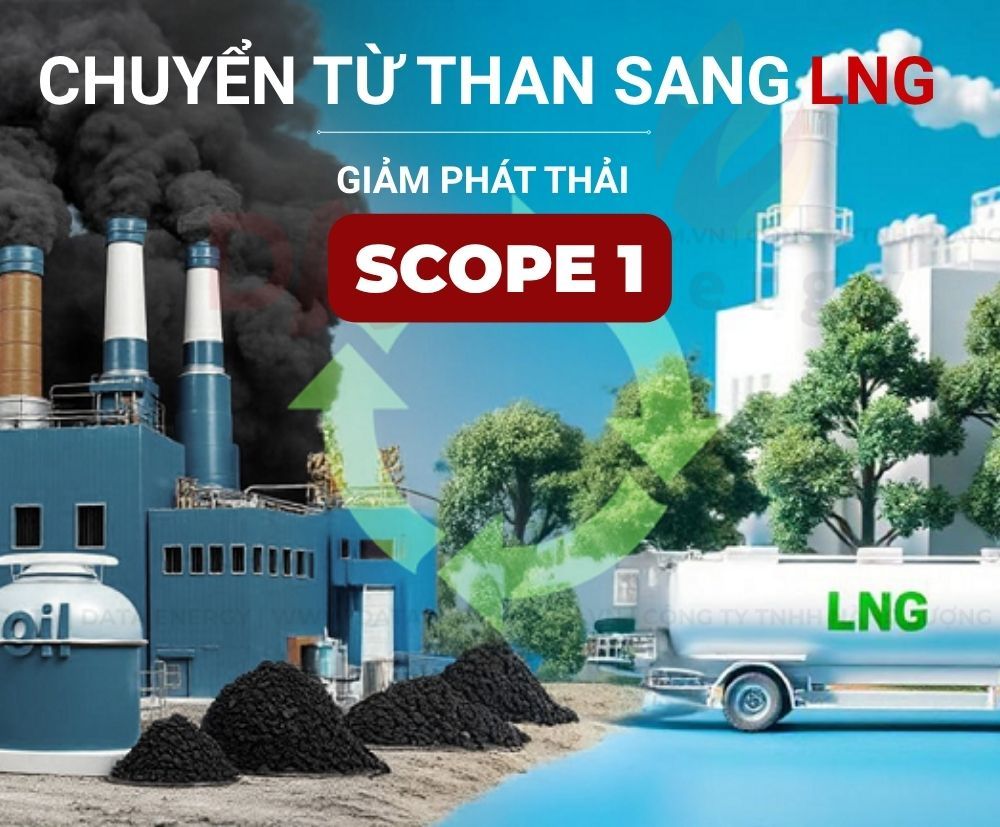
Application implication: LNG is suitable for factories with high consumption (high-capacity boilers, large-scale kilns from 8–10 tons of steam per hour or more), needing long-term supply stability, and located away from CNG infrastructure. LNG is also the preferred choice when factories need to improve their Scope 1 emissions profile per export supply chain requirements.
Practical Applications: Which Does Your Factory Need?
Most factories asking about "methane in cylinders" actually need combustion fuel — for boilers, kilns, dryers, or other thermal equipment. In that case, pure methane in cylinders is not a practical or economical choice.
CNG is suitable when: Consumption is moderate, the factory is located within CNG logistics coverage, and upfront storage infrastructure investment is to be minimized.
LNG is suitable when: Consumption is high (large-capacity boilers, large-scale kilns), large storage capacity is needed, or the factory is located far from CNG infrastructure. LNG is also the right choice when improving Scope 1 emissions for export supply chain compliance.
Pure methane cylinders are suitable when: The factory has a laboratory requiring certified reference gas for instrument calibration, or has a production process requiring tightly controlled high-purity gas input (e.g. electronics, semiconductors, specialty chemicals).

DATA ENERGY COMPANY LIMITED (DATA Energy)
- Supply LPG, CNG, LNG.
- Consult, Design, Install Industrial Gas System.
- Invest Gas System (LPG, CNG, LNG) for the factory.
Latest news
Related Posts