

Why does the fuel cost vary between different factories for the same 'ton of gas'?
18/06/2026When a plant receives a price quote from a gas supplier, it typically encounters two types of units: price per kilogram for LPG, and price per mmBTU or Sm³ for CNG and LNG. Comparing these two figures directly without considering the calorific value will result in incorrect cost calculations.
What is calorific value?
Calorific value (or heat output) is the amount of heat produced when a unit mass or volume of fuel is completely burned under standard conditions. Common units include: kcal/kg, MJ/kg, kcal/Sm³, or mmBTU (1 mmBTU = 1 million BTU ≈ 252,000 kcal).
In practice, there are two types of calorific value:
High calorific value (GCV — Gross Calorific Value): includes latent heat recovered from water vapor in the flue gas. This is often included in gas purchase and sale contracts.
Net Calorific Value (NCV): This excludes latent heat and more accurately reflects the actual efficiency of industrial combustion equipment.
The difference between GCV and NCV for the same gas is approximately 5–10%, so it's important to identify the specific type being used when reading technical specifications or price quotes.
Net Calorific Value of LPG, CNG, and LNG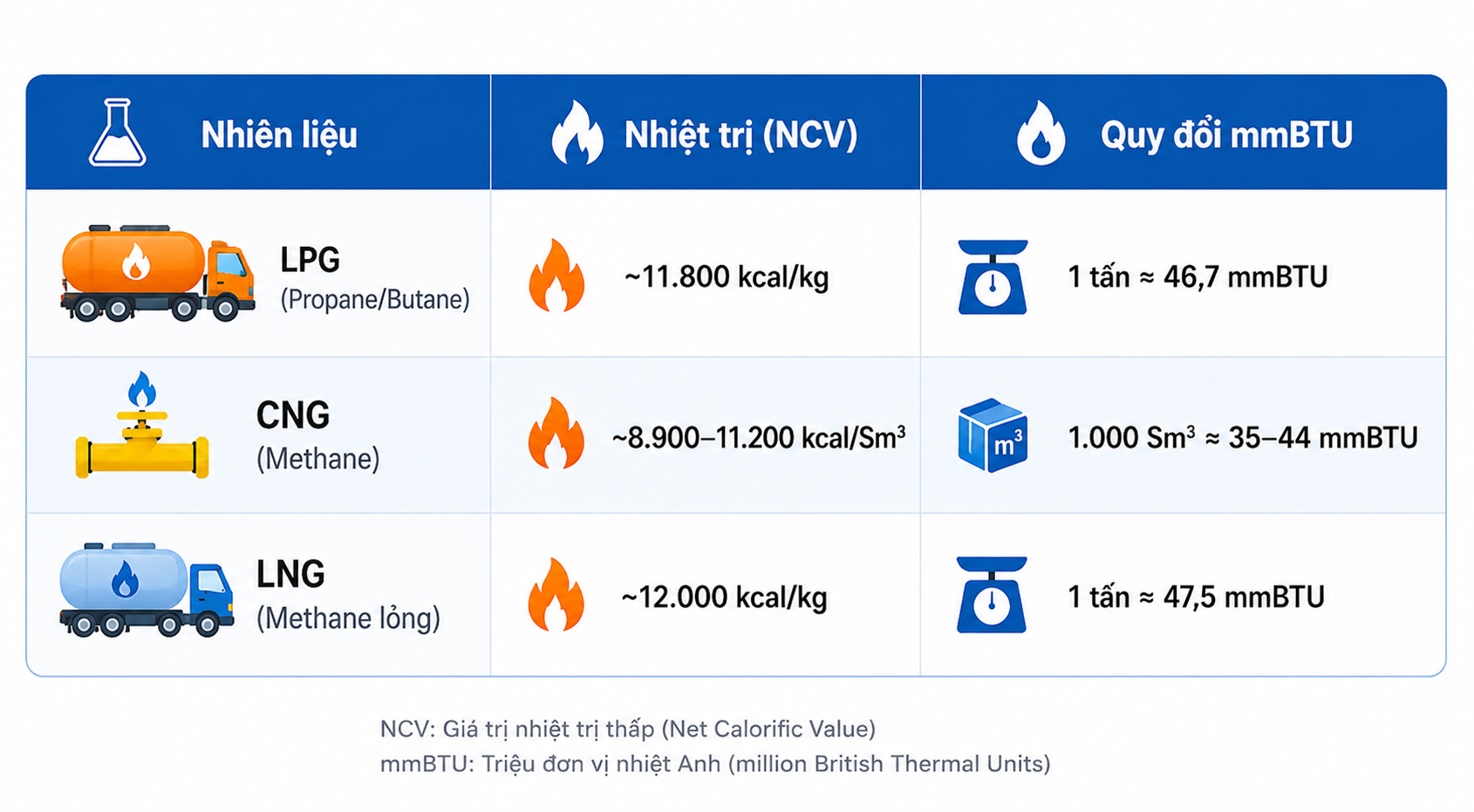
Noted: CNG calorific value fluctuates according to source gas composition and is announced by the supplier with a certificate of composition analysis.
LPG and LNG have quite similar calorific values by mass. CNG is lower in volume (Sm³) — this is a misleading point when comparing prices between the two types.
Three reasons why actual costs vary even for "1 ton of gas":
1. Non-fixed gas composition
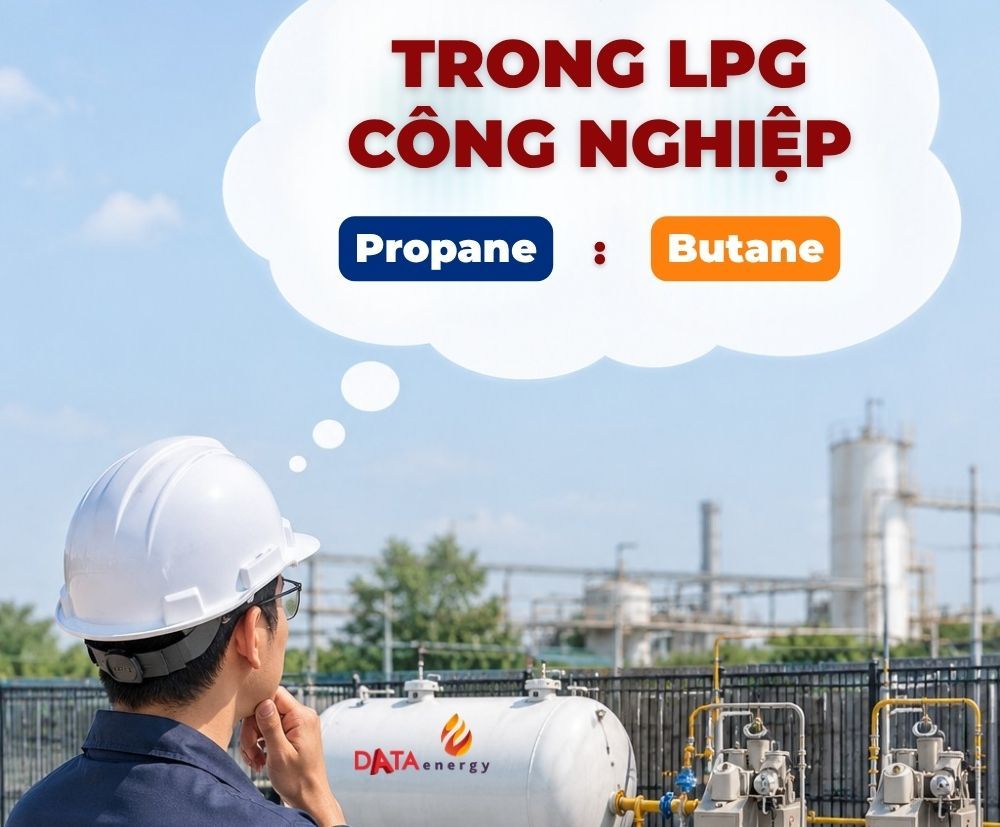
Commercial LPG is a mixture of Propane (C₃H₈) and Butane (C₄H₁₀) with a ratio that varies depending on the source; the common ratio at Thi Vai warehouse is 50:50. Propane has a calorific value of approximately 11,080 kcal/kg, and Butane approximately 11,740 kcal/kg — different mixing ratios result in different calorific values even though they are both called "1 ton of LPG".
2. Inconsistent units of measurement
CNG is measured in square cubic meters (Sm³), LPG in kilograms, and LNG in kilograms or tons. When comparing energy costs between different types, it is necessary to convert to a single unit of heat energy — usually mmBTU or kcal.
3. Combustion Equipment Efficiency
With the same 1 mmBTU of input fuel, a furnace with 85% efficiency and one with 70% efficiency produce different amounts of useful heat. The calorific value of the gas is a necessary condition, but the equipment configuration determines the actual cost of each plant.
What is mmBTU and why does it appear in industrial gas price quotes?
BTU (British Thermal Unit) is a traditional unit of thermal energy in the international oil and gas industry. 1 mmBTU = 1,000,000 BTU ≈ 252,000 kcal ≈ 1.055 MJ.
This unit is common in CNG and LNG transactions because international natural gas contracts are often priced in mmBTU, allowing for direct comparison of energy costs between fuels. For FDI plants, mmBTU is also a commonly used unit according to the parent company's reporting standards.
Quick Conversion:
|
Original Unit |
Exchange |
|
1 mmBTU |
≈ 252.000 kcal ≈ 1.055 MJ |
|
1 ton LPG |
≈ 46,5–47 mmBTU |
|
1.000 Sm³ CNG |
≈ 35–44 mmBTU |
|
1 ton LNG |
≈ 47–48 mmBTU |
Practical Example: Calculating Fuel Costs When Comparing LPG and CNG
A factory consuming 100 tons of LPG/month wants to evaluate the cost of switching to CNG. The first step is not to compare prices—but to convert both to the same unit of heat energy.
Step 1 — Calculate the amount of heat the plant is using
100 tons of LPG × 46.7 mmBTU/ton = 4,670 mmBTU/month
This is the actual amount of heat the plant needs to operate. This number remains constant whether using LPG or CNG.
Step 2 — Calculate the equivalent amount of CNG
With a CNG calorific value of approximately 40 mmBTU/1,000 Sm³:
4,670 mmBTU ÷ 40 mmBTU/1,000 Sm³ = ~116,750 Sm³ CNG/month
Step 3 — Compare costs LPG CNG
|
|
LPG |
CNG |
|
Consumption |
100 ton/month |
~116.750 Sm³/month |
|
Caloric Value |
4.670 mmBTU |
4.670 mmBTU |
|
Cost |
100 tons × cost LPG/ton |
116.750 Sm³ × cost CNG/Sm³ |
Multiply by the actual unit price of each type at the time of calculation to get the cost for comparison.
In Sumary
Calcium value is not just a technical parameter — it is the basis for accurately calculating energy costs when comparing different types of fuel with different units of measurement. Understanding calorific value and how to convert it to mmBTU helps the purchasing department read quotations more accurately, and the operations department control fuel costs more realistically.

DATA ENERGY COMPANY LIMITED (DATA Energy)
- Supply LPG, CNG, LNG.
- Consult, Design, Install Industrial Gas System.
- Invest Gas System (LPG, CNG, LNG) for the factory.
Latest news
Related Posts